HEADS
TAILS
Total Flips: 2,481,092
HEADS
TAILS
Life is funny! Watch the coin!

Just Flip A Coin! 50/50 Coin Toss. Heads or Tails?

Need a quick decision? Use Just Flip A Coin 50/50 coin toss. No ads, no signup—just instant heads or tails results its free and fast. To get started, just click or tap the coin. After each flip, you can view your flip count. You can also customize the look by selecting your preferred color scheme using the color options. Flip as many times as you like and enjoy the experience.

DECISION MAKING

Coin Flip Psychology

A coin flip can do more than produce a random result. It can also reveal how you really feel about the choices in front of you.

When you are stuck between two difficult choices, flipping a coin can provide a quick way to move forward. But an interesting thing can happen after the coin lands: you may immediately feel happy, relieved, or disappointed by the result.

That emotional reaction can be surprisingly useful. If the result disappoints you, it may indicate that you were already leaning toward the other option. In that case, the coin has not necessarily made the decision for you—it has helped uncover what you actually wanted.

?

What Does Your Reaction Tell You?

Imagine the coin lands on an option you thought you wanted. If your first reaction is disappointment, pause and ask yourself why. That feeling may reveal which choice you genuinely prefer.

This idea is sometimes associated with Sigmund Freud and is often referred to as the Freudian Coin Toss. The concept suggests that instead of allowing chance to make the final decision, you pay attention to your emotional response when the result is revealed.

The important part is not the coin itself. The value comes from noticing your immediate reaction before you have time to rationalize or overthink the decision.
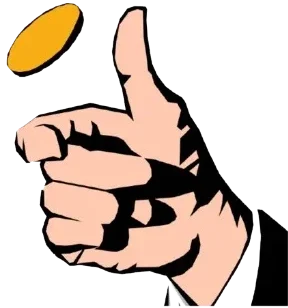
A POETIC PERSPECTIVE

“A Psychological Tip”

Danish poet Piet Hein explored this idea in a poem published in his collection Grooks.

Whenever you're called on to make up your mind,
And you're hampered by not having any,
The best way to solve the dilemma, you'll find,
Is simply by spinning a penny.

No—not so that chance shall decide the affair
While you're passively standing there moping;
But the moment the penny is up in the air,
You suddenly know what you're hoping.

— Piet Hein, “A Psychological Tip”
✓

The Takeaway

A coin toss does not always have to make the decision for you. Sometimes, the most valuable part is discovering how you feel when the result goes one way or the other.

H
A HISTORY OF CHANCE

Coin Flip History

From ancient civilizations to modern sports and everyday decisions, the simple coin toss has been used for centuries to leave outcomes to chance.

01

From Ancient Coins to Modern Decisions

The history of coin flipping stretches back thousands of years. Metal coins were first produced as early as the 7th century BC, while some of the earliest recorded examples of coin tossing can be traced to ancient Rome.

01
ANCIENT ROME 7th–1st Century BC

“Ship or Head”

Romans referred to the practice as “navia aut caput,” meaning “ship or head.” Roman coins could feature a ship on one side and the head or bust of an emperor on the other.

✦ Coin tosses could be used when making important decisions involving property, criminal matters, and marriage.
02
JULIUS CAESAR 49 BC

A Coin With Caesar's Name

Julius Caesar became an important figure in Roman coin history when he began minting coins bearing his name in 49 BC. During this period, coin tosses were sometimes treated as a serious method of resolving disputes and decisions.

“

The outcome of a toss could carry significant authority in the decisions of the time.

03
BRITAIN Medieval Period

Cross and Pile

In Britain, the practice became known as “cross and pile.” Many coins had a cross on one side, while “pile” came from a Middle English term describing the reverse side of a coin.

04
DIFFERENT CULTURES Across History

Many Names, One Simple Idea

Different cultures developed their own names and traditions surrounding the practice. In Peru, the game is known as “face or seal.” Ancient Chinese coin traditions have also been associated with the expression “ship or head.”

CN China Ship or Head
PE Peru Face or Seal
GB Britain Cross and Pile
05
ANCIENT GREECE Early Tradition

Before Coins, There May Have Been Shells

The precise origin of the coin toss remains uncertain. Some historians believe an early version may have originated in Ancient Greece, where players could use a shell instead of a metal coin.

One side of the shell was reportedly covered with a dark resinous material known as black pitch, while the other side remained its natural color. Players could then toss the shell and predict which side would land facing up.

BLACK PITCH
NATURAL SIDE
06
MODERN ERA Today

A Worldwide Way to Choose

Over time, coin flipping became one of the simplest and most familiar ways to make a random choice. Today, people around the world still use it in sports, politics, research, games, and everyday situations.

COIN TOSS TODAY

From Sports to Everyday Decisions

The basic idea has remained remarkably simple: two possible outcomes and one random result.

⚽

Sports

Football, American football, cricket, tennis, fencing, and eSports can use coin tosses to determine starting positions, sides, or other competitive choices.

⚖

Politics

Depending on local rules, a coin toss can sometimes be used as a tie-breaking method when an election produces an exact tie.

✎

Research

Random selection can also be useful in academic settings, including situations where researchers need to resolve an otherwise equal choice.

◉

Everyday Life

People still flip coins to settle small disagreements, choose between two options, or simply make a decision without overthinking it.

50
THE SIMPLE IDEA THAT LASTED

Thousands of Years of Chance

From ancient shells and Roman coins to modern sporting events and digital coin-flip tools, the principle remains unchanged: when two outcomes are possible, a simple toss can leave the final choice to chance.

Scroll to Top